Key Takeaways
- In Germany, certified translations must be produced by sworn translators (beeidigte Übersetzer:innen) who have taken an oath at a German court. Regular translation agencies or bilingual friends won’t satisfy official authorities.
- Typical documents requiring certification include birth certificates, marriage certificates, university diplomas, and residence papers. Requirements differ by Bundesland and the specific authority you’re dealing with.
- Transzlate offers a fully digital, expat-friendly ordering process with 24–72h express options and shipping across the EU and UK, all accessible from your phone or laptop.
- The year 2026 brings stricter data protection rules under GDPR and BDSG, making secure handling of your passport scans and tax records a top priority.
- Use the checklist at the end of this guide to avoid rejections and delays that could derail your visa application, university enrollment, or marriage date.
What Is a Certified Translation in Germany in 2026?
When German authorities ask for a certified translation, they’re not requesting just any accurate translation. They’re asking for a specific legal instrument with binding force.
A certified translation (beglaubigte Übersetzung) is a complete translation of a document, signed and stamped by a sworn translator operating under German court authority. This creates legal validity that public institutions and government agencies recognise.
Here’s what defines a proper certified translation in Germany:
- Translator qualification: The translator must be sworn in Germany through a Landgericht or Oberlandesgericht, not simply any professional translator from abroad
- Certification elements: The translated document includes place and date, a statement confirming accuracy and completeness, the sworn translator’s name, official stamp, and original signature
- Acceptance scope: Required for authorities, courts, universities, notaries, and professional chambers like the Ärztekammer or IHK
- Complete translation: Partial translations are rejected outright: every element of the original document must appear in the target language
- Format preservation: All stamps, seals, and official markings from the original must be described
One note for expats: some consulates require translations done according to specific embassy lists or in a particular country. Always verify requirements with the requesting authority before ordering.
German Legal Standards and How Certified Translations Are Regulated
Germany’s legal framework for certified translations operates across multiple layers of legislation, creating strict compliance requirements that expats must navigate.
The key legal sources include:
- German Court Constitution Act (GVG §§ 189 ff.): Provides the procedural framework for appointing and regulating sworn translators
- State laws on sworn translators (Dolmetschergesetze): Each Bundesland maintains its own regulations and register of approved translators
- German Administrative Procedure Act (Verwaltungsverfahrensgesetz): Mandates that foreign documents in visa applications must be in German or accompanied by certified translations
- EU Service Directive: Applies where relevant for cross-border recognition
Each Bundesland maintains its own register of sworn translators. However, a translator sworn in one German state is generally recognised nationwide for administrative procedures. Some authorities may still insist on translations from specific regions, so expats should verify this in advance.
Practical implications you should know:
- Some authorities require documents translated within the last 6–12 months
- Updated spelling of names (particularly relevant for German orthography standards) may be required
- Data protection under GDPR and the Federal Data Protection Act (BDSG) governs how agencies like Transzlate handle your sensitive documents
Incorrect certification can result in automatic visa rejection, regardless of whether the translation itself is accurate. Form matters as much as content.
Sworn Translators in Germany: Who May Certify Your Documents?
Sworn translators hold a unique legal status in Germany. They’re not simply professional translators with good language skills. They’re court-certified specialists who bear legal responsibility for their work.

Alt-text: The image shows a professional person seated at a desk, meticulously working on official documents with an official stamp nearby. This setting suggests the importance of accurate translation and the production of certified translations for legal purposes, highlighting the role of sworn translators in ensuring compliance with official requirements.
What makes a sworn translator:
- They’ve undergone verification for language competence and reliability
- They’ve passed comprehensive written and oral examinations administered by state authorities
- They’ve taken an official oath at a German court
- They maintain professional liability insurance
- They demonstrate ongoing professional development
Terminology clarity: The terms “beeidigt,” “vereidigt,” “ermächtigt,” and “öffentlich bestellt” all refer to the same legal function. Don’t let the different German words confuse you: they all produce certified translations that official authorities will accept.
Only these specialist translators may add the official certification note, stamp, and signature that German authorities recognise as carrying legal validity.
Important distinction: Notaries in Germany do not typically translate documents. A notary public can certify copies or authenticate signatures, but the translation itself must be produced by a sworn translator.
Transzlate pre-selects sworn translators by language pair and speciality (legal documents versus academic documents, for example) to match expat needs precisely. This removes the friction of searching through official databases yourself.
Types of Documents That Need Certified Translation (With Typical Expat Use Cases)
Different life situations require different documents translated. Here’s a comprehensive breakdown by category with the specific use cases you’ll encounter.
Personal Status Documents
- Birth certificates, marriage certificates, divorce decrees, death certificates
- Use cases: Marriage at Standesamt, family reunification visas, name changes, inheritance cases
Identity & Civil Status
- Passports, ID cards, residence permits, Meldebescheinigungen
- Use cases: Naturalisation (Einbürgerung), permanent residence applications, bank compliance checks
Education & Work
- School leaving certificates, university diplomas, transcripts, reference letters, professional licences
- Use cases: Recognition of qualifications (ZAB, anabin databases), job applications, Blue Card EU applications
- Note: Official test reports from TOEFL, IELTS, or TestDaF are typically issued in English or German and don’t need translation
Financial & Tax
- Salary slips, tax assessments (Einkommensteuerbescheid), bank statements, proof of assets
- Use cases: Mortgage applications, rental applications, visa proof of means
Legal & Corporate
- Contracts, company statutes, commercial register excerpts (Handelsregisterauszüge), powers of attorney
- Use cases: Setting up a company, registering a business, cross-border M&A, court proceedings
Driving & Mobility
- Foreign driving licences, registration papers (Zulassungspapiere), accident reports
- Use cases: German licence conversion, vehicle registration, insurance claims
Transzlate focuses on the most common expat document types. In some situations (like informal employer pre-screening), a simple non-certified translation may suffice. We can advise whether you actually need certification before you order.
Official vs. Certified vs. Notarial Translations: Understanding the Differences
The terminology around such translations confuses many expats. Let’s clarify each term with concrete examples.
| Term | Meaning in Germany | Who Provides It |
| Certified Translation | Translation with sworn translator’s stamp and signature | Sworn translator |
| Official Translation | Non-technical term: same as certified translation | Sworn translator |
| Notarised Translation | Translator’s signature authenticated by notary | Sworn translator + Notary |
| Certified Copy | Confirmation that a photocopy matches the original (no translation) | Notary or authority |
Certified translation: The standard requirement for German authorities. Includes the sworn translator’s stamp and signature, creating official translations with legal weight.
Official translation: Simply a non-technical term that authorities sometimes use. It refers to the same thing as a certified translation by a sworn translator.
Notarised translation: This term comes from other legal systems. In Germany, a notary may notarise the translator’s signature on a certified translation, but the translation itself must still be made by a sworn translator. The notarisation adds an extra authentication layer.
Concrete example: A Spanish consulate in Germany might ask for a sworn translation plus notarial certification of the translator’s signature. Transzlate only provides certified translations which are needed for notarising, but notarising itself must be done externally through a notary.
Always copy the authority’s exact wording into your request to Transzlate so that the correct type of certification (with or without apostille) is provided.
The Transzlate Process for Certified Translations (Step-by-Step)
Transzlate is optimised for expats using phones and laptops. The entire process takes just a few steps and can be completed from anywhere.
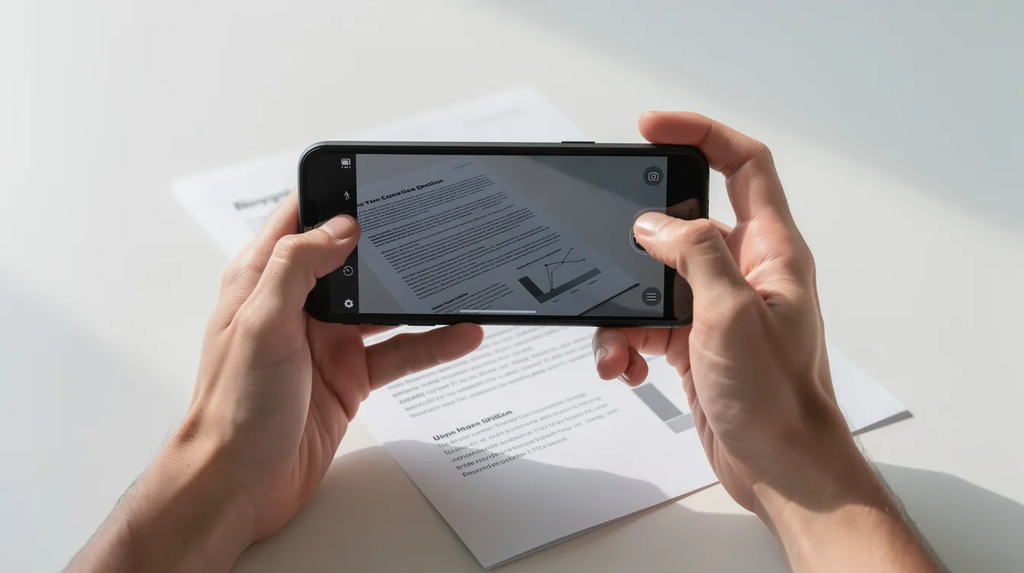
Alt-text: A pair of hands holds a smartphone, capturing a photo of an official document resting on a white surface. This image highlights the importance of accurate translation, as the document may require certified translations for legal purposes.
Step 1 – Upload or Photograph
Upload PDFs or clear smartphone photos via Transzlate’s secure portal. For best results:
- Keep pages flat with no fingers over text
- Ensure all seals and stamps are visible
- Capture margins and back sides where there is text
- Use good natural light for phone photos
Step 2 – Select Languages & Options
Choose your source and target language (Arabic to German, English to German, German to French for relocation). Specify the number of pages/sides. Select your delivery preference:
- Digital-only (PDF)
- Digital + paper original by post
- Express option (digital delivery in 24–48 hours, paper delivered on standard timeline)
Step 3 – Quote & Confirmation
The system generates an instant price estimate where possible. Pricing is per page, based on a standard of 250 words per page. For complex multi-page files, Transzlate sends a binding quote within hours. Delivery times are clearly stated: 24h express or 2–4 working days standard.
Step 4 – Translation & Quality Check
Sworn translators produce the translation. Transzlate performs an internal review checking layout, names, and dates. You then receive a secure PDF and, if ordered, a paper copy by post.
Customer Support: Reach Transzlate via email, call, or WhatsApp in English and German for clarification about authority requirements before ordering.
Turnaround Times and Delivery Options in 2026
Understanding realistic timelines helps you plan around visa interviews, enrollment deadlines, and marriage dates.
Standard Production Times
| Language Pair | Typical Turnaround |
| English–German, Spanish–German | 2–4 working days |
| Rarer languages (Arabic, Chinese) | 4–7 working days |
| Complex legal or technical documents | 4–7 working days |
Express Options
For short documents (1–3 pages) in major languages, 24h–48h express is available. Conditions apply: order cut-off times apply, and production happens Monday–Friday excluding German public holidays.
Digital Delivery
Clients receive a secure PDF by email or via portal login. The sworn translator’s signature and stamp are clearly visible on the document. Some German authorities now accept digitally signed certified translations, but others still require physical translation copies.
Physical Delivery
Transzlate sends original hard-copies via tracked letter or courier within Germany and to EU/UK destinations. Typical arrival: 2–5 working days depending on destination.
Planning advice: Order early before time-critical appointments. Postal delays or additional apostille steps can extend total processing time significantly. Count backwards from your deadline and add buffer days.
Pricing of Certified Translations in Germany: How Costs Are Calculated
Transparency matters when you’re budgeting for bureaucracy. Here’s how certified translation cost is typically calculated.
Pricing is usually per page. In cases where the number of words per page exceeds 250, pricing will be higher than what’s listed in the online form.
Main Price Drivers
- Language combination: Rare languages cost more than common pairs
- Document type: Simple birth certificates versus complex court judgments
- Formatting effort: Documents with heavy formatting require more work
- Number of words: Pages exceeding 250 words incur additional charges
- Urgency: Express surcharges apply for 24–48h turnaround
Indicative Ranges for 2026
| Document Type | Approximate Price Range |
| One-page birth certificate (English→German) | €50–70 including certification |
| Multi-page diploma + transcript | Higher (request quote) |
| Complex legal documents | Request individual quote |
Extra certified copies ordered simultaneously are cheaper than separate orders. Apostille services, if required, incur additional third-party fees that Transzlate cannot control.
Upload your documents to get an exact quote upfront, with no hidden fees for stamps or signatures. Transzlate confirms total cost before any work starts.
Digital Security and Data Protection for Certified Translations in 2026
Expats upload highly sensitive data when ordering certified translations: passport scans, tax records, salary slips, and certified documents containing personal information. Security isn’t optional.
Technical Measures
- Encrypted file transfer using HTTPS/TLS protocols
- Encrypted storage of all uploaded documents
- EU-based servers for data residency compliance
Organisational Measures
- Restricted staff access on a need-to-know basis
- Confidentiality agreements with all translators
- Clear data handling procedures throughout the translation process
GDPR and BDSG Compliance
- Right to access, correction, and deletion of your personal data
- Storage exclusively on EU-based servers
- Privacy policy available in English for expats
With 2026 bringing stricter data protection enforcement, working with a professional translation service that takes compliance seriously protects both your documents and your peace of mind.
Checklist: How to Make Sure Your Certified Translation Is Accepted First Time
Use this actionable checklist before and after ordering to avoid rejections and delays.

Alt-text: A person is seated at a modern desk, reviewing official documents with a checklist in hand, ensuring the accuracy and completeness of the translated documents. This scene highlights the importance of certified translation services for legal purposes and compliance with official authorities.
Before Ordering
- [ ] Confirm with the authority (in writing if possible) whether they require German or another language
- [ ] Clarify whether certified or simple translation is needed
- [ ] Ask about extra steps: apostille, notary, or embassy legalisation
- [ ] Verify if digital submissions are accepted or if paper originals are required
Document Quality
- [ ] Ensure scans/photos show the entire page including seals and margins
- [ ] Capture back sides where there is text
- [ ] Use at least 300 dpi for scans or good natural light for phone photos
- [ ] Check that all stamps and official markings are clearly visible
Spelling and Data Consistency
- [ ] Verify that names, dates of birth, and passport numbers match across all documents
- [ ] Inform Transzlate of known variations (transliteration differences from Cyrillic or Arabic)
- [ ] Note any spelling discrepancies in the original language that authorities should be aware of
Timing
- [ ] Count backwards from your deadline
- [ ] Include translation time (2–7 working days depending on document)
- [ ] Add apostille/legalisation time if required
- [ ] Factor in shipping time to Germany or abroad
- [ ] Add at least 3–5 buffer days for unexpected delays
After Receiving Translation
- [ ] Review spellings, titles, and dates immediately
- [ ] Compare against the original document for accuracy
- [ ] Contact Transzlate for corrections before submitting to authorities
Submission Format
- [ ] Verify if the authority accepts digital certified translations by email/portal in 2026
- [ ] If uncertain, order at least one paper original with wet-ink signature and stamp
Explore the Full Certified Translation Guide Series
This guide is the starting point for certified translations in Germany. For a deeper dive into any specific document, authority, or situation, see the dedicated guides below.
The Certified Translation Essentials
- What exactly makes a translation “Certified” in Germany?
- The role of the Beeidigter Übersetzer: why a standard translator won’t suffice.
- Certified Translation Rejected in Germany: 5 Common Reasons (and How Transzlate Helps You Fix It)
- How to verify a translator’s credentials in the German National Database.
- Digital vs. physical: when do you need the hard copy with the original stamp?
- The cost of certified translations in Germany: a 2026 pricing guide.
- The legal liability of non-certified translations: risks for residency and court proceedings.
- Understanding the “apostille”: do you need one before you translate?
- Fast-track services: how to get a certified translation in 24 hours.
- Data privacy and document security: how our e-commerce shop protects your ID.
- Translating non-Latin scripts: challenges with Arabic, Cyrillic, and Asian characters.
- Does a certified translation ever expire?
- The difference between “certified” and “notarized” translations.
- The Digital Signature Act (2026): how QES-compliant PDF translations are replacing paper at Berlin authorities.
- A checklist for your first appointment at the Bürgeramt with your translations.
Translating Specific Foreign Documents for Germany
- Translating a foreign birth certificate for Germany: what the Standesamt, Ausländerbehörde, and Bürgeramt each require
- Translating a foreign marriage certificate for Germany: Standesamt requirements, apostille rules, and common rejection reasons
- Translating a foreign divorce decree for Germany: what the Ausländerbehörde and courts verify, and when you need the Rechtskraftvermerk
- Translating a foreign police clearance certificate for Germany: Führungszeugnis equivalents and what authorities accept
- Translating a foreign driving licence for the Führerscheinstelle: how to exchange your licence in Germany and what the translation must include
- Translating foreign medical records and vaccination certificates for Germany: health insurance, school registration, and GP requirements
Certified Translations for Visas, Citizenship, and Academic Recognition
- Certified translations for German naturalization (Einbürgerung): the complete document checklist for your citizenship application
- Certified translations for the EU Blue Card in Germany: which documents need translating and what the Ausländerbehörde will check
- Anabin, ZAB, and KMK: how your foreign degree is assessed in Germany, and what translation you need at each step
- Certified translations for the German Skilled Worker Visa (Fachkräfteeinwanderungsgesetz): what BAMF and the embassy require
- Certified translations for family reunification (Familienzusammenführung): marriage certificate, birth certificate, and what the Ausländerbehörde will reject
- Certified translations for the German Job Seeker Visa: what your degrees and employment records need to look like for the consulate
- Certified translations for asylum applications in Germany: what BAMF requires, Sprachmittler rules, and how documents are verified
FAQ: Certified Translations for Expats in Germany
Do German authorities in 2026 accept digital certified translations, or do I always need paper originals?
Only some German authorities and universities in 2026 accept digitally signed certified translations as PDF, especially for online applications. However, most institutions (including Standesämter and many Ausländerbehörden) still insist on paper originals. Always ask the specific office whether a digital pdf version is sufficient, and order at least one paper original from Transzlate if there’s any doubt.
Can I use a certified translation done in another EU country for German authorities?
Within the EU, translations by public sworn translators from other member states may technically be accepted. However, in practice many German authorities explicitly require a translator sworn in Germany. If you’re planning to use a foreign language translation created in another European country, check with the German authority beforehand. When in doubt, commissioning a German-sworn translation via Transzlate is the safer option.
How long is a certified translation valid, and can it expire?
A certified translation does not usually have an expiry date: the document remains valid as an accurate and complete translation of the original. However, if the underlying original document changes (new passport, new marital status), the old translation becomes outdated. Some authorities, especially for immigration or financial checks, may insist on documents translated within a certain number of months. This is their internal policy rather than a legal rule, so always verify requirements.
What is the difference between a certified copy and a certified translation?
A certified copy (beglaubigte Kopie) is a confirmation by a notary or authority that a photocopy matches the original document. No translation is involved. A certified translation is a translation of the content itself into the target language, certified by a sworn translator. Some procedures require both: a certified copy of the original plus a certified translation. Check your authority’s requirements for further information on which combination they need.
Can Transzlate also help with apostilles and legalisation of my documents?
The apostille or legalisation is normally issued by authorities in the country where the original document was created. This isn’t something translators can provide. However, Transzlate can advise expats on the correct order of steps (apostille first, translation second, or as requested) and may coordinate with partner services to simplify the process where legally possible. The proper sequence is typically: Document → Apostille → Certified Translation.
What documents don’t need certified translation for official purposes?
Some documents are already issued in German or English and don’t require translation. Official test reports from TOEFL, IELTS, or TestDaF typically fall into this category. Additionally, for informal purposes like employer pre-screening, a simple non-certified translation may suffice. Transzlate can advise whether your specific situation actually requires certification, and sometimes customers love discovering they can save time and money with a simpler solution.
How do I order online from Transzlate?
Visit Transzlate’s secure portal and complete the online form with your document details. Upload your PDF or smartphone photo, select your language combination and delivery options, and receive an instant quote. The entire process is designed to overcome language barriers for expats and can be completed in minutes from any device. For questions, contact details are available on the website, or reach out via email, call, or WhatsApp in English or German.